

Sourcing women’s business attire is not the same job as sourcing a seasonal fashion drop. A blazer, blouse, skirt or trouser that people wear to work four days a week is judged on fit across a wide range of bodies, on how the fabric looks after twenty washes or dry-cleans, and on whether next year’s reorder still matches the garments already in circulation. Those three requirements — fit, durability and continuity — decide most of what a manufacturer needs to know before quoting.
This guide explains what a womenswear brand, corporate buyer or wholesaler should define before approaching a women’s business attire manufacturer, which fabric and construction decisions carry the most risk in tailored woven garments, and how to plan branding, minimum order quantities and repeat orders. It closes with the questions buyers most often ask. Requirements vary by style, quantity, fabric and destination market, so use the framework to structure your enquiry rather than as a fixed rule set.

Define the business attire program before requesting quotations
“Business attire” describes a dress code, not a specification. Depending on the company and the market it can mean a matched suit, a soft unstructured blazer with a knit shell, a shirt dress, or trousers with a blouse. Two suppliers quoting the phrase “women’s workwear blazer” without further definition will price two different garments, and neither quotation will be comparable.
Decide who wears the garment and how often
Start with the wearer, not the sketch. A front-of-house hospitality team wearing the same blazer daily for two years needs abrasion and pilling resistance, generous ease at the shoulder and a fabric that recovers after long shifts. A brand selling occasion-led business dresses to end consumers can prioritise hand feel and drape over wash cycles. A professional-services firm issuing a uniform allowance sits between the two, and usually needs a size range far wider than a fashion brand’s.
Write down wear frequency, expected service life, laundering method, climate, whether garments are worn under a coat or over a shell, and whether wearers self-select their size from a fit kit. Each of these changes the fabric brief and the pattern brief.
Fix the range architecture early
Most business attire programs work better when the range is split into three tiers: core carryover styles that repeat every season, seasonal styles that refresh colour or silhouette, and accent pieces produced once. Core styles justify committed fabric, a locked size chart and tighter tolerances, because they will be reordered. Accent pieces can take more design risk at a lower quantity.
That split has commercial consequences. It determines where you commit fabric, which styles justify a full size set, and which colours must be reserved against a dye lot. It is also the fastest way to reduce quoted cost on the styles that matter, because the manufacturer can plan fabric and capacity instead of treating every style as a one-off.
Turn the range into a quotable brief
A quotable enquiry for tailored womenswear usually contains the style list with a reference image or Tech Pack per style, target quantity per style and colour, size range, fabric direction with a weight or handle reference, lining and interlining expectations, closure and hardware direction, branding and packing needs, destination market, and target delivery window. Where a decision is still open, say so — a marked assumption is easier for a supplier to price than a silent gap.
A structured product-development review converts that brief into the construction questions that must be answered before a first sample. If you are still assembling specifications, our guide to the Tech Pack for woven womenswear covers what each page should contain.
| Tier | Typical styles | What it justifies | Main risk if undefined |
|---|---|---|---|
| Core carryover | Signature blazer, tailored trouser, white shirt | Committed fabric, locked size chart, retained dye reference, tighter tolerances | Reorders drift in colour and measurement |
| Seasonal refresh | Colour or print variants, seasonal skirt or dress | Shared pattern block, shorter fabric commitment | New pattern work repeated unnecessarily |
| Accent / capsule | Statement jacket, occasion dress, matching set | Design risk at lower quantity | Low quantity priced as if it were core volume |
Choose suiting fabric against the real wear and care cycle
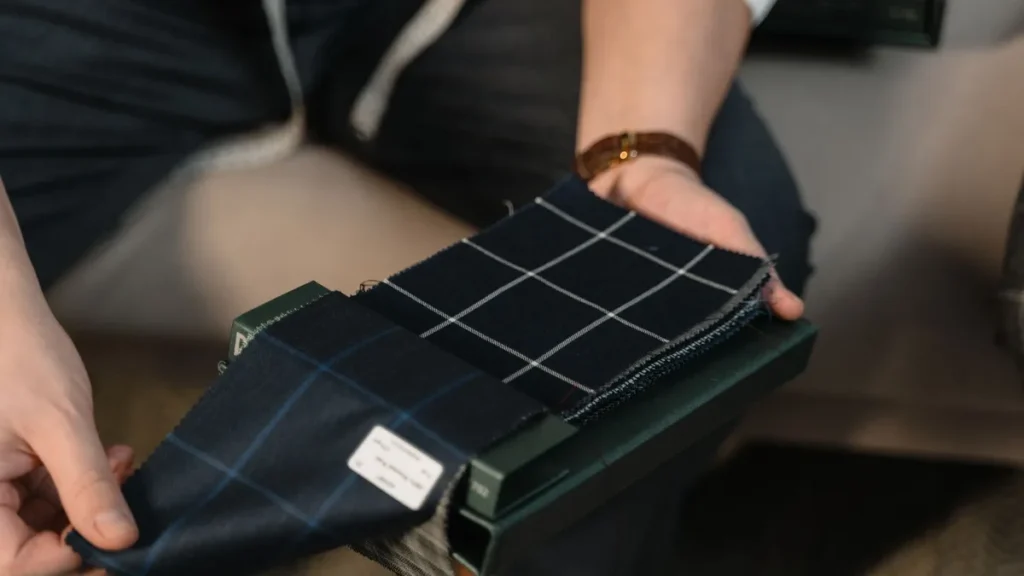
Fabric is where business attire programs most often fail quietly. The fabric approved on a hanger in a showroom can pill at the inner sleeve after a season, relax at the seat, shine under an iron, or shift half a shade between dye lots. None of that is visible in a swatch, and all of it is predictable if the requirement is written as a test method rather than as an adjective.
Match the fabric to the garment’s job
Tailored jackets and trousers generally need a stable woven with enough body to hold a pressed edge and enough recovery to survive sitting. Wool and wool-blend suitings, polyester–viscose suitings and stretch cotton twills all serve this role, with different trade-offs in cost, breathability, wrinkle recovery and care. Blouses and shirt-weight garments need a different brief again, where opacity, hand feel and seam appearance dominate. Our guide to choosing woven fabric for womenswear covers how to work backwards from silhouette to specification.
Whatever the direction, the approved material must be identified precisely: mill reference where applicable, composition, construction, weight, usable width, finish and colour. “Poly-viscose suiting, mid weight” is a conversation, not a specification. The fabrics and trims process is where that description becomes a controlled article reference, along with the interlinings, linings, buttons and zips that share responsibility for how a tailored garment behaves.
Write performance requirements as test methods
Buyers get better results when a requirement names the test method and who pays for it, rather than asking for fabric that is “durable” or “colourfast”. Common reference methods for business attire include ISO 12945-2 for pilling and surface fuzzing by the modified Martindale method, ISO 5077 for dimensional change after washing and drying, ISO 105-C06 for colour fastness to domestic and commercial laundering, and ISO 13936-2 for seam slippage resistance in woven fabrics. These are published methods; they describe how something is measured, and they do not by themselves state a pass level or imply that any supplier holds a certification. Buyers set the acceptance level and decide which styles are tested.
Care instructions belong in the same conversation, because they define which test is even relevant. Symbol-based care labelling is standardised in ISO 3758, while goods sold in the United States fall under the FTC Care Labeling Rule, which requires a reasonable basis for the care instructions given. Deciding that a blazer is dry-clean-only, or that a blouse must survive domestic laundering, changes fabric selection, interlining, lining and trim choice at the same time.
| Symptom in wear | Usual origin | Reference method | Decide at |
|---|---|---|---|
| Pills at cuff, inner sleeve or seat | Fibre blend, yarn and finish | ISO 12945-2 | Fabric approval, before bulk commitment |
| Garment shrinks or grows after care | Untested dimensional change | ISO 5077 | Fabric approval, then applied to pattern |
| Colour fades or stains other garments | Dye and finish versus stated care | ISO 105-C06 | Fabric and care-label approval |
| Seams open at stress points | Fabric construction, seam type, allowance | ISO 13936-2 | Fabric approval plus construction spec |
| Reorder colour does not match | New dye lot without a retained reference | Agreed shade band and retained standard | First bulk, before the reorder exists |
Test methods describe measurement, not compliance. Agree in writing which styles are tested, at what stage, against which acceptance level, and who bears the cost and the retest.
Control fit, size range and tailored construction
Tailored womenswear is unforgiving. A dress with a soft silhouette hides a two-centimetre pattern error; a single-breasted blazer does not. Business attire is also usually sold or issued across a wider size range than fashion, and often to people who cannot try the garment on before it arrives. Both facts push work upstream into the size chart and the fit process.
Build the size chart before the pattern
A size chart is a commercial decision, not a technical formality. It defines who can wear the garment, how many sizes must be cut, and how much grading work each style needs. Decide the base size, the measurement points, the grade rule between sizes, and the tolerance for each point before pattern work starts.
Body measurement definitions are standardised in ISO 8559-1, which is a useful common vocabulary when a brand, a fit model agency and a factory each use slightly different terms for the same measurement. What the standard cannot do is choose your target body — that comes from your own customer or workforce data. Where a corporate programme covers a broad workforce, decide early whether one block covers the whole range or whether larger sizes need a separate block rather than an extrapolated grade.
Make fittings answer specific questions
Every fit sample should have a stated objective and a written decision. A first fit sample tests silhouette and balance. A revised sample tests whether the correction worked. A size-set sample tests the grade at the extremes of the range, which is exactly where an extrapolated grade fails. A pre-production sample confirms approved fabric, trims, labels, workmanship and measurements together as the final reference for bulk.
Fit tailored garments on people as well as on a form. A dress form will not show whether a sleeve pitch restricts reaching forward, whether a jacket collar lifts when the wearer sits, or whether a skirt rides at the waist during a working day. The pattern, sampling and fit process should keep every comment tied to the correct sample version, and our pre-production sample checklist sets out what has to be closed before bulk begins.
Construction details that decide whether it reads as tailored
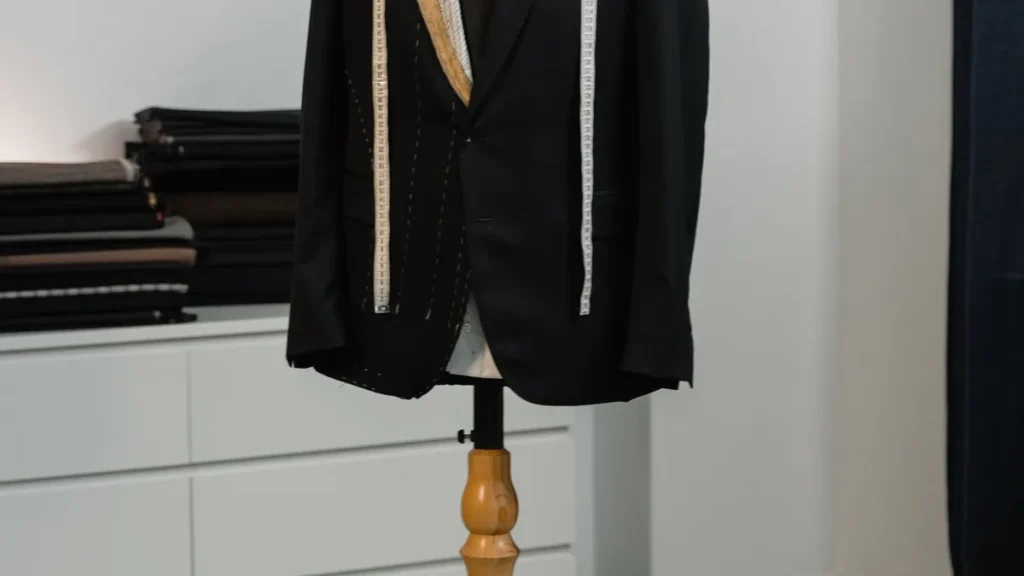
In tailored womenswear, a handful of internal decisions carry most of the visual result. Interlining choice and fusing parameters determine whether a lapel rolls or looks flat and bubbled. Shoulder construction and sleeve head treatment decide the shoulder line. Lining type and the ease built into it decide whether the jacket moves with the wearer or pulls. Pocket, vent, buttonhole and edge-stitch specifications decide whether the finish looks considered or generic.
These should be written into the specification rather than left to the sample maker to reproduce from a reference garment. The same discipline applies to the shell and bottom-weight styles that surround the jacket: shirts and blouses, tailored trousers and skirts each have their own critical points, and blazers and lightweight jackets carry the highest construction risk in most business attire ranges.
Plan branding, MOQ, reorders and colour continuity
Business attire is bought in programmes rather than single drops, so the decisions that look administrative at first — labels, minimums, retained references — are the ones that determine whether year two costs more than year one.
Treat branding as an approved component
Main labels, size labels, care labels, hangtags, woven or embroidered marks, buttons and packaging are components with artwork versions, materials, dimensions, placement and attachment methods. Each should be approved as a component before bulk, not described for the first time at the packing table. Fibre content, country of origin and care information carry legal requirements in most destination markets; the FTC’s guidance on labelling under the Textile and Wool Acts is a useful reference for United States sales. A manufacturer can execute approved artwork; responsibility for what the artwork must legally say should be agreed rather than assumed. The private-label and packaging brief is where those details are recorded.
Understand what actually sets the minimum
Buyers often ask for a single MOQ figure. In practice the minimum for tailored womenswear is usually set by the fabric and colour rather than by the sewing line, because a mill has its own minimum per colour and a dye lot cannot be split indefinitely. A style ordered in one colour and five sizes behaves very differently from the same style in four colours. Splitting quantity across colours, or across two similar styles that share a fabric, is often the practical lever — our guide to MOQ, sampling cost and lead time explains how the three are connected. Bulk planning, capacity and in-line checks are handled through the bulk production process.
Protect continuity before you need it
Continuity has to be set up during the first bulk order, when nobody is thinking about the reorder yet. Retain an approved shade standard and agree the acceptable shade band. Record the exact fabric article and, where possible, reserve fabric or greige against forecast repeats. Keep the approved pre-production sample, the final measurement specification with tolerances, the trim card and the artwork versions as a single closeout packet by style and version.
When the repeat order arrives, that packet is the baseline — but materials, availability, colour, measurements, quantities and market rules should still be reconfirmed rather than assumed unchanged. Mills discontinue articles, and a substitution that looks equivalent on paper can behave differently in a pressed lapel.
| Decision | Made at | Record to keep |
|---|---|---|
| Size chart and grade rules | Before pattern work | Measurement specification with tolerances, by size |
| Fabric and trim approval | Before bulk commitment | Article reference, trim card, test results if agreed |
| Colour standard | First bulk | Retained shade standard and agreed shade band |
| Branding artwork | Before bulk | Approved artwork version, placement and attachment spec |
| Bulk reference | Pre-production approval | Approved sample plus written conditions closed |
| Packing and assortment | Before packing | Packing spec, carton marks, assortment by size and colour |
Questions buyers ask about business attire manufacturing
What is the minimum order quantity for women’s business attire?
There is no single figure, because the minimum is usually driven by the fabric and colour rather than by the sewing operation. A style in one colour using a stocked fabric behaves differently from the same style in four colours using a mill-run suiting, and a structured blazer with lining, interlining and hardware carries more setup than a simple blouse. Ask for the minimum per style, per colour and per fabric separately, and ask what changes if quantity is shared across two styles using the same material.
How long does a business attire order take?
Lead time is a sequence, not a single number: development and fit sampling, fabric and trim procurement, pre-production approval, bulk production, inspection and shipment. Fabric availability and the number of fit rounds are usually the largest variables, and both are partly under the buyer’s control. When comparing suppliers, confirm where each quoted timeline starts and stops — a quote counted from approved pre-production sample is not comparable with one counted from first enquiry.
Should I choose OEM, ODM or private label?
These describe two separate decisions. OEM and ODM describe who develops the product — your own specification versus a factory-developed style adapted to your brand. Private label describes whose name is on it. You can buy an ODM-developed blazer under your own label, or have a fully OEM style produced without exclusivity. Our guide to OEM, ODM and private label sets out how to decide, and what the scope and approvals should say in each case.
Which fabric is best for a corporate blazer?
It depends on the care cycle and the climate more than on any single fibre. Wool and wool blends give the best press retention and recovery in a tailored jacket but usually assume professional care. Polyester–viscose suitings handle frequent laundering and generally cost less, with a different hand feel. Stretch cotton twills suit softer, less structured jackets. Decide the care instruction first, then choose the fabric that can satisfy it, then verify with the relevant test methods.
How do I make sure a reorder matches the original garments?
Set it up during the first order. Retain an approved shade standard with an agreed acceptable shade band, record the exact fabric article rather than a generic description, keep the approved pre-production sample and measurement specification with tolerances, and confirm at reorder whether the fabric article is still available. Colour drift and quiet fabric substitution are the two most common causes of a mismatched repeat.
Can one manufacturer make blazers, blouses, skirts and trousers?
Ask specifically rather than generally. Tailored jackets, shirt-weight blouses and bottom-weight trousers use different machinery, different operator skills and different pressing equipment. A supplier able to build a coordinated range in-house keeps colour, fabric and fit decisions in one place, which matters when a jacket and trouser must match. Where part of a range sits outside a factory’s core competence, it is better to know that at the enquiry stage than after the first sample.
What should I send with my first enquiry?
Style list with a reference image or Tech Pack per style, target quantity per style and colour, size range, fabric direction, care expectation, branding and packing requirements, destination market and target delivery window. Mark open items as open. A supplier can price assumptions; it cannot price silence.
Business attire rewards decisions made early and recorded properly. The programme structure, the fabric brief written as test methods, the size chart, and the retained references are what make the second order easier than the first.