
Woven womenswear category
Women’s Woven Matching Set Manufacturing
Develop coordinated woven tops and bottoms with color, fabric behavior, shared trims, proportion and packing requirements controlled across both pieces.
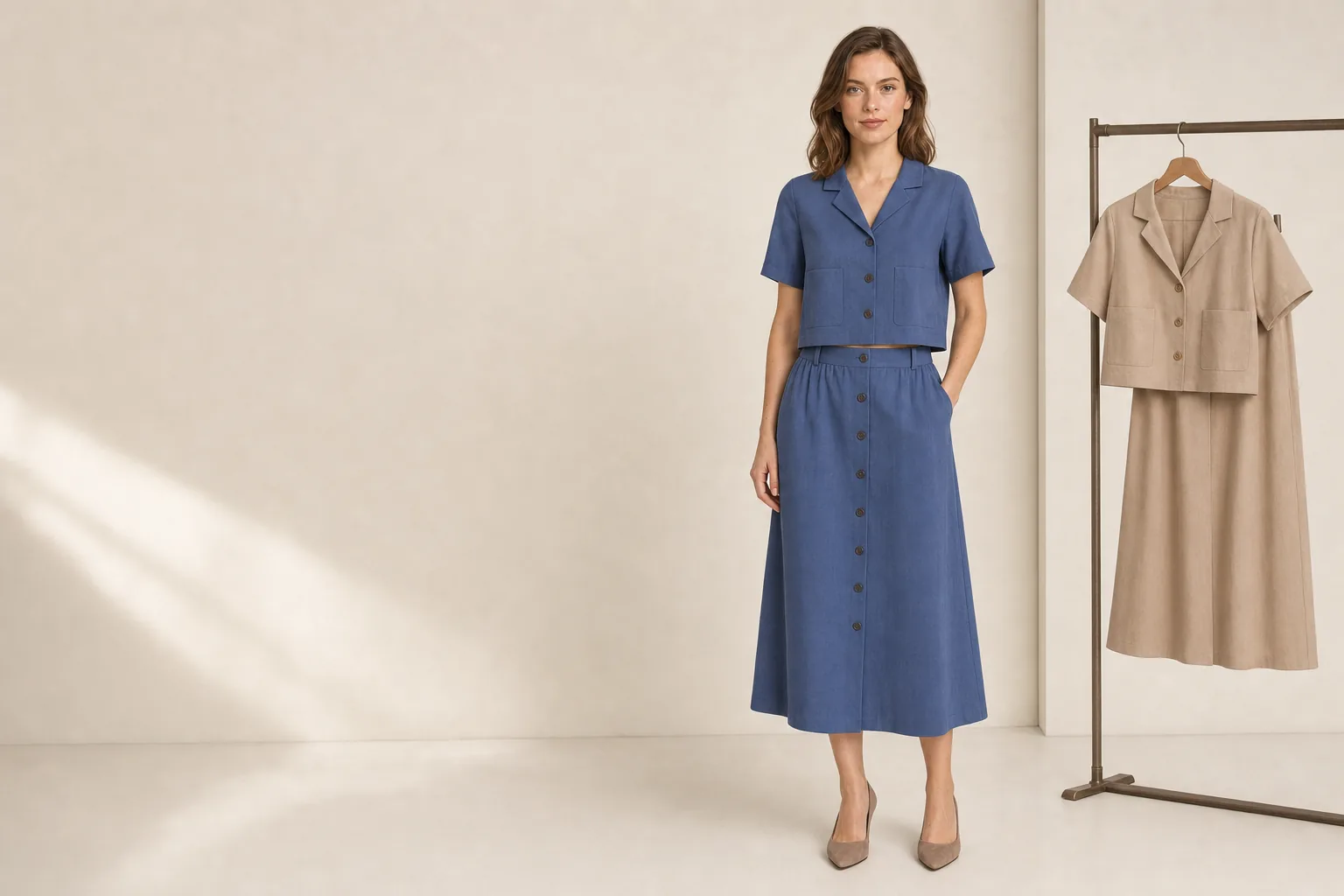
Matching set development
Approve two individual garments and the relationship between them.
Each piece needs its own pattern, measurements and construction review. The set also needs a shared standard for color, fabric lot, trims, proportions, labeling and presentation.
Piece-level briefs
Separate front, back, detail and measurement information for top and bottom.
Coordination rules
Shared fabric, color, print, hardware and visible workmanship expectations.
Set presentation
Size pairing, labels, folding, bagging and carton identification.
Silhouette & details
Coordinate proportion without treating two pieces as one pattern.
The top and bottom may use related design language while needing different support, seams, closures and fit approvals.
Set pairings
- Blouse and skirt sets
- Shirt and trouser sets
- Top and short combinations
- Vest, blazer or layered pairings
Top direction
- Cropped, standard or tunic lengths
- Fitted, relaxed or wrap bodies
- Sleeveless to long sleeves
- Button, tie or zipper openings
Bottom direction
- Skirts, trousers and shorts
- Structured or elastic waists
- Straight, flared or wide silhouettes
- Coordinated pocket and closure details
Shared language
- Matching or placed print
- Repeated piping or topstitching
- Common buttons and hardware
- Aligned trims and brand components
Matching set fabrics
Control shade and behavior across connected pieces.
Potential directions include cotton poplin, linen blends, crepe, woven satin, jacquard, twill and other articles suitable for the selected top-and-bottom combination.
Approval should consider whether both pieces use the same article and lot, how print or nap direction is managed, and whether each garment needs different lining, interfacing or pocketing.
- Cross-piece shade consistency
- Print scale and placement
- Different support needs by piece
- Shared trim color and finish

Matching set customization
Create cohesion through proportion, color and repeated details.
The strongest set specifications state what is shared, what differs and how the two finished pieces should be paired.
Proportion pairing
Adjust top length, waist position and bottom volume as a coordinated look.
Color & pattern
Define exact shade matching, engineered placement or intentional contrast.
Repeated details
Carry buttons, piping, topstitching, trims or hardware across both pieces.
Set identification
Confirm size pairing, SKU logic, labels, hangtags, bagging and carton marks.
Matching set quality points
Check each garment, then verify the pair.
Inspection points are confirmed against the approved garment and order requirements.
Explore our capabilitiesShade consistency
Compare top and bottom color, print ground, wash effect or surface appearance.
Proportion
Review top hem, waist meeting point, overlap and combined silhouette on the fit reference.
Shared components
Check button, trim, thread, hardware and label color or finish across both pieces.
Pairing & packing
Verify style, color and size combination, folding method, bag labels and set completeness.
Develop each component
Explore the garment categories behind a coordinated set
Use the individual category pages to define fit and construction before confirming how the pieces connect.
Shirts
Define top shape, collar, sleeve, placket and clean woven finishes.
Explore ShirtsSkirts
Review waistband, volume, opening, lining and hem behavior.
Explore SkirtsBlazers & light jackets
Build structured two-piece directions with coordinated tailoring details.
Explore Blazers & light jacketsMatching set quality points FAQ
Questions tied to this garment category.
Answers stay connected to the actual design, material and confirmed order inputs.
01Should the top and bottom use one Tech Pack?
They can be presented within one project, but each garment should have clear views, construction notes and measurements. Shared materials, trims and pairing rules should be identified separately.
02How is color consistency managed across a set?
The specification should define the approved color and fabric article for both pieces. Fabric lots, directional surfaces, print grounds and any intentional contrast need to be traceable during review.
03Can buyers order different size pairings for top and bottom?
Pairing requirements should be raised in the commercial brief because they affect style and size identification, labels, packing and order breakdown. Feasibility is reviewed against the actual project.
04How are matching sets packed?
The buyer should specify whether pieces are folded, hung, bagged or labeled together or separately. Approved size-pairing and carton instructions are then part of the packing reference.
Start with what you have
Send both garment references and explain exactly how the set should be coordinated.
Share a Tech Pack, reference image, sketch or sample together with target quantity and timing. We will use those inputs to review construction, materials and the next useful step.
Send Your Brief